
The Lexus IS 350 in Wimberley, TX.
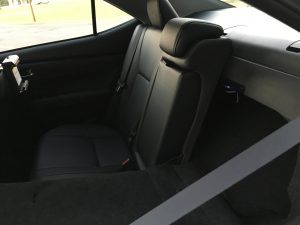
Launched in 1989, Lexus easily carved out a niche in the premium segment with its reliability and exceptional customer service. But while it was upscale, it wasn’t sexy. Sporting a new design DNA, Lexus has clearly evolved from bland to brilliant. Sitting on Rioja Red leather seats, I recently drove the Lexis IS 350 during a weeklong test for Latino Traffic Report.
 For some, the new face of Lexus, led by the signature spindle grille, can be polarizing, but it definitely has fans. According to Lexus, when the second-generation IS took on the new Lexus look in 2013, it became so popular that the restyled 2017 version only involved minor adjustments to its exterior appearance.
The third generation IS originally came in three trim levels but for 2018, that was reduced to two available trim levels, the 300 (200t is now the 300) and 350 that I tested. Horsepower increases by five in 2018 across all powertrains, including the specially tuned 3.5-liter V6 on the 350 that now produces 311 horsepower and 277 lb.–ft. of peak torque and is matched to an eight-speed automatic transmission. It responded with instant speed, accelerating from zero to 60 miles per hour in 5.6 seconds. While all-wheel drive is available, I drove the rear-wheel-drive model with the eight-speed Sport Direct Shift automatic transmission. Additional powertrains include a 2.0-liter turbo four-cylinder matched to an eight speed multi-mode automatic or the 3.5-liter matched to a six-speed automatic.
 A sporty car should hug the road not float above it, especially on curves, plus the steering should be tight and responsive. Lexus achieves this with the Drive Mode Select system, standard on all IS trims. This technology comes with Eco, Normal, Snow, and Sport modes to customize the ride and handling. To save gas, select Eco, but for a sportier experience, select Sport. For an additional $3,155, the test model included the F Sport package, ramping up its sportiness further with Sport S/S+ mode which I engaged for tighter handling on a curvy road on the way to Wimberley, TX.
While the IS 350 should achieve and EPA estimated fuel economy of 19 miles per gallon (mpg) in the city and 28 mpg on the highway, I averaged 21.9 mpg.
The IS also included safety features, starting with the standard Lexus Safety System+ that included advanced technology like the pre-collision warning system, Lane Departure Alert with Steering Assist, and High-Speed Dynamic Radar Cruise Control. However, I was surprised to find that the blind spot warning system was a stand-alone option for $600. At this price point it should be standard. For 2018, however, the Enform Safety and Service Connect systems are complimentary for the first ten years.
Pricing for the 2018 Lexus IS starts at $38,820. The as-tested price, including the blind spot monitor, came to $49,530.
Sí: The Lexus IS 350 embraces its sportiness, enhanced by exceptional technology plus the red leather seats were gorgeous.
No: While an affordable option, a blind spot monitor should be a standard feature on a premium brand.


 On the outside, the all-new Tiguan shares several design cues with its larger sibling, the
  Active Control, a unique feature with 4Motion, also allows more intrepid drivers to chose among four driving modes—On-road, Snow, Off-road, and Custom Off-road. To fine tune the On-road experience further, four additional modes—Normal, Sport, Eco, and Custom—can be engaged with the push of a button. Along curvy mountain climbs and descents, I tested the Sport mode. It improved handling via tighter steering but didn’t offer a noticeable increase in power.
 The new Tiguan tackles the versatility challenge by adding 10.6 inches in length, giving it up to 58 percent more cargo space than the current model. It also includes a 50/50 split third row third-row seat, suitable for children, on entry-level trims with front-wheel drive (FWD) and makes it available on models with VW 4Motion AWD technology. The 40/20/40 split second-row bench can recline and slide seven inches fore and aft. Both rows fold down to create a maximum of 65.7 cubic feet of cargo room.
 On the outside, the base has halogen headlights, LED daytime running lights and taillights, foglights with a cornering function, heated exterior mirrors with integrated turn-signal indicators, and 17-inch wheels. By comparison, the SEL Premium comes with 19-inch wheels, LED headlights with the Adaptive Front-lighting System, rain-sensing wipers, and power-folding exterior mirrors with puddle lights. For added convenience, the SEL Premium also includes the foot-activated, hands-free Easy Open power liftgate.


 The three winners each stood out in their segments for different reasons.


 According to the automaker, 2017 was the ninth consecutive year of record sales for Subaru of America and the tenth consecutive year of sales increases, assisted in part by the Impreza’s popularity. For 2017, the manufacturer redesigned its stalwart compact sedan and hatchback, and to mark the occasion moved Impreza production to the United States, specifically, its Lafayette, IN plant.
 The compact segment excels at economy and fuel efficiency, but the Impreza did have fun-to-drive moments as well, assisted in part by 70-percent increased rigidity and a lower center of gravity.
 Standard safety features include, Vehicle Dynamics Control, symmetrical AWD, 24-hour roadside assistance, and a rear vision camera.


 Fernández worked with artisans in seven different communities throughout

 The classic midsize sedan’s groundbreaking redesign begins with an all-new body with a lower, wider stance, a lighter and more rigid unibody structure, new LED headlamps that sharply resemble those of Honda’s higher-end brand, Acura, a sweeping greenhouse, a bold front fascia, and a longer and lower hood. These features combine to create a more upscale appearance than the previous model.
 Under the hood, the V6 is no longer an option, but the tenth generation Accord can be powered by three four-cylinder engines, including Accord’s two new turbos—a 1.5-liter direct-injected turbo with dual Variable Timing Control (VTC) 192 horses and 192 lb.–ft. of torque, and a 2.0-liter direct-injected turbo with dual VTC and 252 hp and 273 lb.–ft. of torque. Both can be matched to a six-speed manual transmission on the Sport trim. A Continuously Variable Transmission (CVT) can be mated to the 1.5- liter and a new ten-speed automatic transmission is available to pair with the 2.0-liter. Both engines and configurations were available to drive at the launch as well as the third-generation 2018 Honda Accord hybrid. All models at the launch performed handily, including both engines, as did the hybrid.
 At the launch, only fuel economy figures for the 1.5-liter were available. Matched to the six-speed manual transmission, the Accord Sport should achieve 26 miles per gallon (mpg) in the city and 35 mpg on the highway. We achieved an average of 32 mpg at the launch. The CVT will achieve one mpg better than the manual in the city on the Sport trim but on other trims it earns four mpgs more in the city and three mpgs better on the highway.
 Standard creature comforts on the Accord include dual zone climate control, push button start, a capless fuel filler, a customizable seven-inch TFT digital display in the gauge cluster, seven-inch audio display (with knobs), and USB audio interface. Higher-end features include an eight-inch audio display, heated leather seats (front and back), a power moonroof, Head-Up Display, wireless phone charging (Android only), and Honda satellite-linked navigation.


 It’s powered by a 1.5-cylinder four-cylinder engine that produces 132 horsepower and matched to a Continuously Variable Transmission with intelligence and a sport mode to enhance its performance. Despite its size, the engine had a louder than average rumble. The test model had an EPA estimated fuel economy of 28 miles per gallon (mpg) in the city and 35 mpg on the highway. I averaged 29.5 mpg on the weeklong test drive.
 The test model added stand-alone options like Entune Premium Audio ($525), mudguards ($129), and TRD Performance Exhaust ($649) and air filter ($80).


 Testaments to the increasing popularity of the small SUV segment, both models are top sellers for their brands. Equinox sales have reached nearly two million units since its launch and it is Chevrolet’s second-best selling vehicle overall, after the Silverado. Similarly, new sales records designate the Rogue as Nissan’s top-selling vehicle in the United States.


 Nissan Connect with Navigation was included on the Rogue SL along with a seven-inch display, Nissan Voice Recognition for navigation and audio, and a motion activated tailgate. The SL Premium Package ($2,020) added a panoramic sunroof, and the Platinum Package ($770) added intelligent cruise control, among other features.

 The Pacifica stirred controversy when Fiat Chrysler Automobiles (FCA) opted to resurrect its name for the Chrysler minivan, replacing the Town and Country. Once introduced, however, it quickly made amends, named the 2017 North American Sport Utility Vehicle at the North American International Auto Show in Detroit. A trailblazer in the minivan segment, FCA US added 37 minivan firsts to its portfolio for a total of 115 innovations in the segment.
 With plug-ins, however, there’s a trade-off—the longer the electric range, the longer it takes to recharge, especially using a 120-volt outlet in the garage. On paper the Pacifica’s all-electric range of 30–33 miles on electric energy seemed limited, but the minivan recharged overnight and on the test drive, the range didn’t dissipate as soon as I pressed the gas, as others have. It held true and on some occasions recharged to extend the range so that the Pacifica rarely needed to switch to gasoline power.
 Standard created comforts begin with a beautifully appointed interior inspired by Juneau, Alaska with ivory leather seats, blue accent stitching and black piping, heated front seats, remote start, three-zone climate control, a seven-inch full color customizable driver information display, and the Uconnect infotainment system with an 8.4-inch touchscreen.
