
Henio Arcangeli, senior vice president of the Automobile Division of American Honda Motor Co., accepts the award for 2018 North American Car of the Year for the Honda Accord at the 2018 North American International Auto Show on 1/15/18.
DETROIT (January 15, 2018) – Latino Traffic Report (LTR) has learned that the Honda Accord, Volvo XC60, and Lincoln Navigator were crowned as the winners of the 2018 North American Car, Utility and Truck of the Year (NACTOY) awards today at the North American International Auto Show.
The awards are among the most prestigious in the industry because they are chosen by a panel of more than 60 jurors from print, online and broadcast media across the United States and Canada. Votes were tallied confidentially by Deloitte LLP and remained sealed until they were announced today by NACTOY officers, president Mark Phelan, vice president Matt DeLorenzo and secretary-treasurer Lauren Fix at Cobo Center in Detroit.
 The three winners each stood out in their segments for different reasons.
“Honda seems to have executed some sort of magic trick—not only is this tenth generation Accord far sleeker and more decisively styled than its predecessor, it’s somehow roomier inside, too,” said Chris Paukert, a NACTOY juror and managing editor of Road Show by CNET. “Even in low-end trims, it drives well and offers a strong amount of standard equipment.”
According to Henio Arcangeli, Jr., senior vice president of the Automobile Division and general manager of Honda Sales, American Honda Motor Co., Inc, “Honda took a clean-sheet approach to reinventing America’s most popular car, and we couldn’t be prouder to receive this honor for Accord as the North American Car of the Year,” he said. “We’re especially proud for the production associates in Ohio where Accord has been built to the highest quality standards for over 35 years.”

Standing next to the all-new Volvo XC60, Anders Gustafsson, president and CEO of Volvo Cars USA holds the award for 2018 North American Utility of the Year won by the 2018 XC60.
The XC60 is the second Volvo in three years to win the coveted award after the XC90 won in 2016. “Like the XC90, the XC60 offers Volvo’s distinct brand of luxury and it may even be more appealing than its bigger brother. The ride is exemplary, and when smartly equipped, it is a fine value,” said NACTOY juror and freelance auto writer Kirk Bell.
“We are so proud the XC60 has won this prestigious award,” said Anders Gustafsson, president and CEO of Volvo Cars USA. “It is a very tough competition and we thank all the judges for recognizing the great style, technology, and engineering in the XC60.

Kumar Galhotra, president, The Lincoln Motor Company holds the 2018 Truck of the Year award for the all-new Lincoln Navigator.
NACTOY Juror Ron Sessions of the New York Daily News said, “The 2018 Navigator received a more dramatic update than its Ford Expedition sibling and its impact for the brand will be stronger as a result. With its design now aligned with the Continental, the Navigator becomes an even more important image—and the profit-maker for Lincoln.”
Accepting the award for Lincoln was Kumar Galhotra, president, The Lincoln Motor Company. “Lincoln is honored to be named the best among such a strong field of competitors,” he said. “The entire Lincoln team is very proud of the work that was done to create a truly differentiated, luxury Lincoln experience in our all-new Navigator.”
Chosen from dozens of new vehicles, jurors evaluated the finalists based on segment leadership, innovation, design, safety, handling, driver satisfaction and value for the dollar. The process started in June 2017 by determining vehicle eligibility and includes three rounds of voting. LTR attended the launches of the XC60 and Accord last year and can attest that these vehicles are class leaders.
Now in their twenty-fourth year, the awards are selected by a group of respected automotive journals with lifetime appointments to the jury, distinguishing them from other industry awards distributed by a single publication, website, radio, or television station. For a list of all the nominees go to For more about NACTOY and its history: http://northamericancaroftheyear.org/.


 According to the automaker, 2017 was the ninth consecutive year of record sales for Subaru of America and the tenth consecutive year of sales increases, assisted in part by the Impreza’s popularity. For 2017, the manufacturer redesigned its stalwart compact sedan and hatchback, and to mark the occasion moved Impreza production to the United States, specifically, its Lafayette, IN plant.
 The compact segment excels at economy and fuel efficiency, but the Impreza did have fun-to-drive moments as well, assisted in part by 70-percent increased rigidity and a lower center of gravity.
 Standard safety features include, Vehicle Dynamics Control, symmetrical AWD, 24-hour roadside assistance, and a rear vision camera.


 Fernández worked with artisans in seven different communities throughout

 The classic midsize sedan’s groundbreaking redesign begins with an all-new body with a lower, wider stance, a lighter and more rigid unibody structure, new LED headlamps that sharply resemble those of Honda’s higher-end brand, Acura, a sweeping greenhouse, a bold front fascia, and a longer and lower hood. These features combine to create a more upscale appearance than the previous model.
 Under the hood, the V6 is no longer an option, but the tenth generation Accord can be powered by three four-cylinder engines, including Accord’s two new turbos—a 1.5-liter direct-injected turbo with dual Variable Timing Control (VTC) 192 horses and 192 lb.–ft. of torque, and a 2.0-liter direct-injected turbo with dual VTC and 252 hp and 273 lb.–ft. of torque. Both can be matched to a six-speed manual transmission on the Sport trim. A Continuously Variable Transmission (CVT) can be mated to the 1.5- liter and a new ten-speed automatic transmission is available to pair with the 2.0-liter. Both engines and configurations were available to drive at the launch as well as the third-generation 2018 Honda Accord hybrid. All models at the launch performed handily, including both engines, as did the hybrid.
 At the launch, only fuel economy figures for the 1.5-liter were available. Matched to the six-speed manual transmission, the Accord Sport should achieve 26 miles per gallon (mpg) in the city and 35 mpg on the highway. We achieved an average of 32 mpg at the launch. The CVT will achieve one mpg better than the manual in the city on the Sport trim but on other trims it earns four mpgs more in the city and three mpgs better on the highway.
 Standard creature comforts on the Accord include dual zone climate control, push button start, a capless fuel filler, a customizable seven-inch TFT digital display in the gauge cluster, seven-inch audio display (with knobs), and USB audio interface. Higher-end features include an eight-inch audio display, heated leather seats (front and back), a power moonroof, Head-Up Display, wireless phone charging (Android only), and Honda satellite-linked navigation.


 It’s powered by a 1.5-cylinder four-cylinder engine that produces 132 horsepower and matched to a Continuously Variable Transmission with intelligence and a sport mode to enhance its performance. Despite its size, the engine had a louder than average rumble. The test model had an EPA estimated fuel economy of 28 miles per gallon (mpg) in the city and 35 mpg on the highway. I averaged 29.5 mpg on the weeklong test drive.
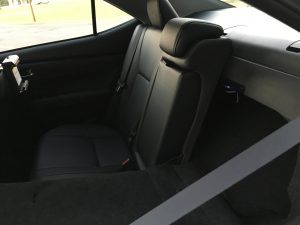 The test model added stand-alone options like Entune Premium Audio ($525), mudguards ($129), and TRD Performance Exhaust ($649) and air filter ($80).


 Testaments to the increasing popularity of the small SUV segment, both models are top sellers for their brands. Equinox sales have reached nearly two million units since its launch and it is Chevrolet’s second-best selling vehicle overall, after the Silverado. Similarly, new sales records designate the Rogue as Nissan’s top-selling vehicle in the United States.


 Nissan Connect with Navigation was included on the Rogue SL along with a seven-inch display, Nissan Voice Recognition for navigation and audio, and a motion activated tailgate. The SL Premium Package ($2,020) added a panoramic sunroof, and the Platinum Package ($770) added intelligent cruise control, among other features.

 The Pacifica stirred controversy when Fiat Chrysler Automobiles (FCA) opted to resurrect its name for the Chrysler minivan, replacing the Town and Country. Once introduced, however, it quickly made amends, named the 2017 North American Sport Utility Vehicle at the North American International Auto Show in Detroit. A trailblazer in the minivan segment, FCA US added 37 minivan firsts to its portfolio for a total of 115 innovations in the segment.
 With plug-ins, however, there’s a trade-off—the longer the electric range, the longer it takes to recharge, especially using a 120-volt outlet in the garage. On paper the Pacifica’s all-electric range of 30–33 miles on electric energy seemed limited, but the minivan recharged overnight and on the test drive, the range didn’t dissipate as soon as I pressed the gas, as others have. It held true and on some occasions recharged to extend the range so that the Pacifica rarely needed to switch to gasoline power.
 Standard created comforts begin with a beautifully appointed interior inspired by Juneau, Alaska with ivory leather seats, blue accent stitching and black piping, heated front seats, remote start, three-zone climate control, a seven-inch full color customizable driver information display, and the Uconnect infotainment system with an 8.4-inch touchscreen.


 Overall, Nissan was the most overall awarded brand with five category wins and Mazda swept the three non-luxury CUVs, categories. Other highlights from the event included a near vertical climb up a hill with the Ram Power Wagon, assisted by a winch and the Land Rover Discovery, assisted by cruise control.