
My parents bought a new Buick LeSabre every ten years for three decades. Soon after that nameplate was retired in 2005, the LaCrosse was born and for 2017, the third generation has emerged. On a recent weeklong test drive of the 2017 LaCrosse Premium by Latino Traffic Report, the elegant sedan fairly floated along Austin’s highways and byways.
Earning a full-size classification from the EPA with the last generation, the newest version is even longer, lower, and wider than the previous model. That translates into a roomier interior, specifically, 42 inches of front legroom, 40 inches in the rear, and 15 cubic feet of cargo room in the trunk. The 60/40 split rear seat also folds to extend cargo  space further. It also bears the new face of Buick, featuring a new design on its waterfall grille including the return of a three-color Buick tri-shield insignia, accented by wing-shaped elements.
Trim ranges include: LaCrosse, Preferred, Essence, and Premium. While the test model was front-wheel drive Premium, it can also be configured with all-wheel drive. Like any big sedan, the LaCrosse offers a smooth ride and takes it to another level on the Essence and Premium, with the available electronically controlled Continuous Damping Control active suspension with selectable Touring and Sport modes.
All LaCrosse models are powered by a new 3.6-liter V6 that produces 310 horsepower and 282 lbs.–ft. of torque. Paired to a new eight-speed automatic transmission, featuring Stop/Start and Active Fuel Management, the 2017 LaCrosse FWD has an EPA estimated fuel economy for is 21 miles per gallon (mpg) in the city and 31 mpg on the highway. I achieved an average mpg of 20.1 mpg on the test drive.
 The Buick IntelliLink (left) infotainment system with a frameless eight-inch-diagonal color touchscreen featuring Apple CarPlay, Android Auto and OnStar guidance for three months, OnStar 4G LTE with Wi-Fi hotspot integration three-month data plan, and OnStar five-year basic plan with limited vehicle mobile app features, monthly diagnostics report, and dealer maintenance notification are standard on all trims,
All models also include dual-zone air conditioning, AM/FM stereo with up to 60 preset channels and two USB ports, Bluetooth, cruise control, driver and front passenger eight-way power seat, leather-wrapped steering wheel, Rear Park Assist.
Really posh features on the Premium test model, like massage controls in the heated and cooled front seats, a heated steering wheel, and Head-Up display are standard.
Innovative safety technology from General Motors includes the Teen Driver feature allows parents to set controls, review driving habits, and encourage safe driving habits even when they are not in the vehicle is standard on all trims. Additional standard safety features include a rear vision camera.
The Premium brings safety technology like Forward Collision Alert, Head-up Display reflected onto windshield above steering wheel, Lane Keep Assist, Rear Cross-Traffic Alert, Safety Alert Seat, Side Blind Zone Alert. The test model added the Driver Confidence Package 1 with Rear-Cross Traffic and Blind Zone Alert.
The test model was also equipped with an automatic rear sunshade with the Sun and Shade package ($1,550), adaptive cruise control and Automatic Parking Assist, via the Driver Confidence Package 2 ($1,690), and navigation and a Bose stereo from the Sights and Sounds Package ($1,145).
Pricing for the 2017 Buick LaCrosse starts at $32,990. The as-tested price came to $48,395.

Sí: Larger, more luxurious, and better looking, the all-new 2017 LaCrosse embodies the full-size sedan that Buick lovers expect.
No: Safety features like a blind spot monitor should be available on more trim levels.


 d, Chrysler will notify owners, and dealers will replace tire placard label, free of charge. The recall is expected to begin July 28, 2017. Owners may contact Chrysler customer service at 1-800-853-1403. Chrysler’s number for this recall is T37.

 “This is the biggest and boldest Volkswagen we have ever built in the United States, delivering the distinctive design and craftsmanship we’re known for, now with room for seven,” said Hinrich J. Woebcken, CEO of the North American Region, Volkswagen. “The Atlas marks a brand new journey for Volkswagen to enter into the heart of the American market.”

 For those a little more concerned with fuel economy, the Atlas will offer a 2.0-liter turbocharged four-cylinder engine that produces 235 horsepower and 258 lb.–ft. of torque. For families who’d like more power, the Atlas can also be outfitted with a 3.6-liter VR6 that delivers 276 horses and 266 lb.–ft. of torque. Both are matched to an eight-speed transmission. The maximum towing for the V6 is 5,000 lbs. with a factory-installed hitch. The standard Start/Stop technology on both engines that cuts the engine off at a stop, also helps conserve gas and while noticeable, it was less jarring than other systems.
 EPA testing is still underway, but the front-wheel drive VR6 models are expected to earn around 18 miles per gallon (mpg) in city driving and 25 mpg on the highway. As the 2.0-liter engine will have late availability, no mpg information is currently available.
 Standard convenience features include a rearview camera, two-zone (first row and second/third row) climate control, cruise control, the MIB II infotainment system, and a 6.5-inch capacitive touchscreen display.


 horsepower and an estimated 109 lbs.–ft. of torque. On the Hybrid, it’s matched to a quick-shifting six-speed double-clutch transmission, an electric motor that delivers an estimated 43 horsepower with an estimated maximum torque of 125 lbs.–ft., and a 1.56 kWh lithium-ion polymer battery (with a lifetime warranty). With an 8.9 kWh lithium-ion polymer battery, the Plug-in Hybrid provides an all-electric range (before the gas-powered engine kicks in) of more than 27 miles while the Ioniq Electric offers an estimated driving range of 124 miles with a 28 kWh lithium-ion polymer battery . Mated to a single-speed reduction-gear transmission, the electric motor has a maximum output of 118 horsepower and 218 lbs.–ft. of torque. The Ioniq Electric has an EPA-estimated 136 miles per gallon gasoline equivalent (MPGe) rating, better than any electric vehicle sold in the U.S.
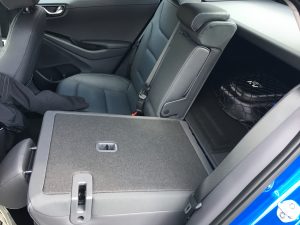 Enhancing the car’s fuel efficiency and dynamic driving characteristics, the
  driver can select either SPORT or ECO modes. On the launch, the SPORT mode did add oomph but it was the Plug-in Hybrid and Electric models that offered noticeably smoother rides.

 While SUVs aren’t known for their fuel efficiency, the new Acadia is 700 pounds lighter, which should help stretch a gallon of gasoline a little farther.
 The test model also included the All Terrain package with badging throughout, an advanced Active Twin Clutch AWD system, 20-inch aluminum wheels, a cargo management system, and seating for five. While the Acadia can offer seating for seven, the All Terrain package replaces the third-row of seating with covered storage bins and a cargo management system in the rear cargo floor. For this trip, we focused on storage above the floor. The second row deployed easily to expose 79 cu. ft. of cargo space. We had room for multiple boxes and bags, but most impressive, was that the Acadia also fit a twin mattress. We didn’t need to tow but if we had, the Acadia included a Trailering Package ($650) that gives it a maximum towing capability of 4,000 pounds.
 The user-friendly GMC IntelliLink system has been enhanced to include phone integration technology via Apple CarPlay and Android Auto compatibility. The test model also included navigation, a 4G LTE WiFi hotspot, OnStar, and SiriusXM Satellite radio for three months, as well as a panoramic sunroof. The shade, however, snaps back with some force so little fingers may need to beware.
 More common safety technology, like a blind spot monitor and rear cross-traffic alert, are available on the SLE-2 trim and are standard on the SLT-1 trim and above. Advanced technology like forward collision alert and the safety alert seat that vibrates to warn the driver, come with the Driver Alert Package II, standard only on SLT-2 and Denali trims.
 Audi will notify owners, and dealers will replace the gearbox in the affected vehicles, free of charge. The recall is expected to begin in May 2017. Owners may contact Audi customer service at 1-800-253-2834. Volkswagen’s number for this recall is 37K6.

 “Across the board, our data tells us that Spanish-speaking customers are well-informed when it comes to in-vehicle technology,” Inch said. “In addition to using OnStar core services, we’ve seen that Spanish-speaking customers are likely to use the myChevrolet mobile app to remote start their vehicles, lock their cars and even check their vehicle’s diagnostics.”


 When you step up from a Honda to an Acura, you might expect a little more bells and whistles. You can get ’em, but at a price. TLX models with the 2.4-liter engine can be upgraded to the Technology package and models with the 3.5-liter engine can add Technology or the line-topping Advance Package. Both were included on the test model. The Technology package brought essential features like blind spot information, forward collision warning, and a rear cross traffic monitor, as well as convenience features like perforated leather seating, navigation with voice recognition, the AcuraLink communication system, and Acura ELS Studio premium audio.
 The Advance package added Collision Mitigation, Adaptive Cruise Control, ventilated front seats, and front and rear parking sensors, among other features.