Valerie Menard

Valerie Menard is a freelance writer and published author with 16 years of reporting about the auto industry for Latino publications.

SUV Launch: 2018 Chevy Equinox

 Launches  Comments Off on SUV Launch: 2018 Chevy Equinox
Aug 072017


Believe it or not, the battle of the bulge (the war with the scale not the German counteroffensive in 1944) affects cars too. Dropping pounds can produce certain challenges for vehicles but in the search for better fuel economy, it’s worth it. Chevrolet took 400 pounds off of the all-new 2018 Equinox and Latino Traffic Report recently attended the launch in Asheville, North Carolina to test drive the redesigned compact sport utility vehicle (SUV). Turns out it has more to brag about than just being lean.

“In a word, crossover customers want one thing, everything. From comfort and connectivity to efficient performance and safety, the all-new 2018 Chevrolet Equinox delivers on all counts,” said Steve Majoros, director of marketing, Chevrolet Cars and Crossovers.

Turbos have been at the heart of Chevy’s approach to fuel economy and it really ramps up with the Equinox, which offers a choice of three—a 1.5-liter, 2.0-liter, and a 1.6-liter turbo diesel (a segment first). This makes the Equinox the first Chevrolet model in North America to use an all-turbocharged, multi-engine powertrain lineup. The 1.5-liter and diesel are matched to a six-speed automatic and the 2.0-liter is matched to a nine-speed automatic transmission.

GM estimates that the highway fuel economy on front wheel drive (FWD) models equipped with the 1.5-liter will reach 32 miles per gallon (mpg) on the highway, 29 mpg with the 2.0-liter, and 40 mpg with the diesel.

For many manufacturers, the compact SUV market is the new sweet spot and Chevrolet is no exception. Equinox sales have reached nearly two million units since its launch and it’s Chevrolet’s top selling SUV and second-best selling vehicle overall, after the Silverado.

An elegant interior complements the new exterior design, particularly on the top trim levels that offer striking color combinations for the leather seating and accents.

Inside, there’s also 3.5 cubic feet of interior volume for a total of up to 63.5 cubic feet of maximum cargo space, this despite a reduction in overall length of 4.7 inches, making it easier to park and maneuver.

This family vehicle is not without safety innovations. A rearview camera is standard on all trims, as well as Teen Driver that allows parents to set controls and review in order to encourage driving habits, even when they are not in the vehicle. The optional and improved Safety Alert seat buzzes the driver’s left or right upper thigh as a warning and the available Rear Seat Reminder pings when the ignition is turned off to remind drivers to check the back seat for children. These and other safety features like a blind spot monitor and rear cross traffic alert are available although only on higher-end trim levels.

The MyLink infotainment system designed to support Apple CarPlay and Android Auto, as well as the OnStar 4G LTE Wi-Fi hotspot, can be matched to a standard seven- or an available eight-inch-diagonal color touchscreen. Other convenience features include cruise control, air conditioning, and keyless start.

Available in L, LS, LT and Premier trim levels, and FWD or all wheel drive combinations, pricing for the next-generation 2018 Equinox will start at $24,525.


DS Virgin Racing Season Ends, Lopez Takes Podium

 Noticias  Comments Off on DS Virgin Racing Season Ends, Lopez Takes Podium
Aug 042017


Latino Traffic Report has learned that DS Virgin Racing’s Jose Maria Lopez secured his second podium of the season during the thrilling Formula E season finale in Montreal, with team-mate Sam Bird finishing fourth to secure the team fourth place overall in the constructors’ championship. The result caps off the most successful season for the British team in terms of silverware, with an impressive six podiums and two wins, together with two pole positions and two fastest laps.

“I’m really pleased with the result, especially after what happened in race one, and to finish the season this way,” said Lopez. “I could tell straightaway what a difference the team had made to the car since my last race and it was frustrating our qualifying group meant we were unable to show this. Nevertheless, I enjoyed the race and of course the whole season, as well as working with the DS Virgin Racing team.”

Lopez  showed front-running pace but was drawn in the first qualifying group leaving him with the tougher of the track conditions to contend with, and starting from P11.

As the 37-lap race got underway, Lopez moved quickly up the field to lie sixth. Bird then made contact with the wall at Turn 3, damaging his steering and compromising both his handling and energy consumption during his first stint. Despite this, he was able to keep pushing and remarkably only lost one further place before pitting on lap 17, with Lopez stopping soon after and the two running third and fourth after the pit stop shuffle.

In the closing stages, race-leader and rival Felix Rosenqvist had dropped to second and into the clutches of Bird but with less usable energy, he was unable to maintain the pressure which allowed Lopez to get ahead. Lopez pushed until the chequered flag but was unable to get the better of Rosenqvist to cross the line third, one place ahead of his team-mate.

Team Principal Alex Tai commented: “My congratulations go to Jose for his superb podium today and his success in his debut season. Our achievements wouldn’t be possible without such a dedicated team, together with our partners, and we’re looking forward to continuing this momentum into season four.”

DS Performance Director Xavier Mestelan Pinon added: “It was great to end DS Performance’s second Formula E season with a podium, and to add to our tally this season. Throughout the season, the team has developed the performance of the DSV-02, which has allowed us to fight at the top regularly and I’d like to thank the whole DS Virgin Racing team, to Total and our partners for this. This season has also been rich in terms of technological breakthroughs for us as well as brand awareness across the globe.”

Car Review: 2017 Honda Accord Hybrid Long-term Part 2

 Honda, Reviews  Comments Off on Car Review: 2017 Honda Accord Hybrid Long-term Part 2
Jul 302017


Despite predictions to the contrary, gasoline-electric hybrids have carved a niche in the automotive industry. According to hybridcars.com, the first to market in the United States in this segment was Honda with the 1999 Insight. Since then, the Insight has come and gone, twice, but Honda continues to bring hybrids to the lineup. I spent three months in the 2017 Accord Hybrid Touring for Latino Traffic Report and the most important thing to know is that this hybrid saves gas, in fact it’s the best in the segment.

Long-term test drives beg for a car to be driven, so I did, more than 5,000 miles over Texas highways, to small towns, like Burnet and Bryan, and big cities, like Houston, Dallas, and San Antonio. It’s a comfy ride over the long haul and nimble enough to scoot through traffic.

While its fuel economy is stellar, the hybrid’s styling also deserves a mention. Redesigned for 2016, the Accord took on a more sculpted, angular appearance, Marking the Accord’s fortieth anniversary, Honda introduced its sibling, the hybrid that benefits from the Accord’s new look while adding enhancements under the hood.

At the heart of its fuel saving ability is its two-motor hybrid system combined with an ultra-efficient 2.0-liter i-VTEC Atkinson Cycle engine and matched to an electric continuously variable transmission. It achieves a peak-combined output of 212 horsepower, the highest of any midsize hybrid sedan.
Initially, the test model proved to be more fuel efficient in cities than on highways, which is as is should be according to its EPA estimated fuel economy rating of 49 miles per gallon (mpg) in the city and 47 mpg on the highway. Over time, however, fuel economy on the highway also improved, especially with cruise control engaged. I averaged about 48.5 mpg in three months—city and highway combined. When it comes to cost, I spent more than $300 on gasoline.

I engaged the Econ button that can be used at all times, as well as an EV button that operates the hybrid on electric power for small distances, to maximize efficiency. For more power, I pushed the Sport mode button that gave the hybrid better acceleration.

Displays in the instrument cluster and center stack, including a seven-inch touchscreen, helped me maintain gas saving driving habits, like coasting and accelerating smoothly from a stop. While I found them to be helpful, they also raised a little anxiety when the fuel economy slipped.

All Accord Hybrids come with Honda Sensing, a suite of safety features with advanced technology like forward collision warning, lane keep assist, and adaptive cruise control that allows the driver to set a distance behind a vehicle that cruise control maintains, automatically.

I never grew accustomed to Honda’s LaneWatch camera, also standard, that can be engaged with the turn signal to view the blind spot on the right. The picture wasn’t that clear, especially at night, and focusing made it distracting. A blind spot monitor, available on other Honda models, would be preferable.

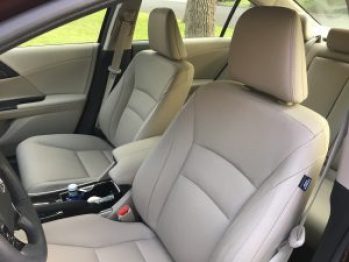
Creature comforts included Ivory leather seats, with heated seats in the front and back, navigation, dual-zone climate control (Honda seems to have addressed the air conditioning system’s habit of fading at stops in previous hybrids), a moonroof, and a multi-view back-up camera. I got used to the lack of knobs for volume control and put the CD player and the MP3 USB port to good use on several road trips.

Pricing for the Accord starts at $30,480. Pricing for the as-tested 2017 Accord Hybrid was $36,790.

Sí: The Accord Hybrid Touring achieved what’s expected of a hybrid, it saved gas, but it also came in a handsome package with nice creature comforts.

No: Honda LaneWatch just doesn’t have the intuitiveness of a blind spot warning system and the lack of clarity on the screen is distracting.


Ford Awards Driving Dreams Grants

 Noticias  Comments Off on Ford Awards Driving Dreams Grants
Jul 242017


Ford Driving Dreams

Latino Traffic Report has learned that Ford Motor Company Fund, the philanthropic arm of Ford Motor Company, recently named the recipients of the Ford Driving Dreams (FDD) Grants at the 88th Annual LULAC National Convention in San Antonio, Texas. A total of $400,000 in scholarships and grants will be awarded to ten Councils and LULAC National Educational Service Centers, Inc. (LNESC) to support programs that encourage students to graduate from high school, and provide resources to help them pursue a higher education.

Ford Fund will award eight LULAC Councils $20,000 each in FDD Grants to implement educational programs over two school years in collaboration with a local education entity. Grant recipients from 2015–LULAC Council #2862 in Sacramento, California. and LULAC Council #313 in Chicago, Illinois–were selected to each receive a $10,000 renewal grant for an additional school year to continue their successful programs to promote on-time high school graduation.

“Ford Fund is very proud of its collaboration with LULAC. Together we provide invaluable resources to help the councils build a stronger and brighter future for thousands of students in their own communities,” said Joe Avila, manager, Ford Motor Company Fund. “Education has long been a priority for Ford and we remain committed to helping our young people advance in school and reach their academic dreams.”

The new 2017 grant recipients are:

  • Council #2890 Hollister, California
  • Council #5294 Pilsen, Illinois
  • Council #13004 Holland, Michigan
  • Council #20009 Philadelphia, Pennsylvania
  • Council #214 Houston, Texas
  • Council #44017 South Jordan, Utah
  • Council #4614 Richmond, Virginia
  • Council #11126 Washington, DC
  • Council #2862 Sacramento, California (renewal grant)
  • Council #313 Chicago, Illinois (renewal grant)

Angelica Eggers is a beneficiary of the Ford Driving Dreams Grants program through the San Antonio LULAC Council #4619. Eggers participated in the Ford Driving Dreams program during her freshman and sophomore years at South San Antonio High School. This fall, she plans to attend Texas A&M University in San Antonio and major in criminology. “My hard work is paying off and because of the Ford Driving Dreams Grants program and LULAC, I am excited about going to college to earn my degree and reach my goals,” said Eggers.

“Helping young people succeed is a constant effort we have made possible in association with Ford Motor Company Fund so students can graduate high school on time and pursue a college education. Today, we celebrate and recognize the work of the Councils who are making sure that their communities are being empowered through academic excellence,” said Brent Wilkes, chief executive officer of LULAC.

Earlier this year, Ford Fund impacted the lives of San Antonio students with a donation of 10,000 new books to elementary schools, a reading party for second and third-graders at Miguel Carrillo, Jr. Elementary School, and $50,000 in scholarships awarded to 25 high school students preparing for college this fall.

Joe Avila, manager, Ford Motor Company Fund.

Ford Driving Dreams Grants has invested more than $1.3 million since its launch in 2010. More than 1,500 students and 60 Councils have been able to leverage their success to impact the lives of high school students across the country. Each FDD grant recipient will develop a sustainable program that reflect the local education landscape and relies on partnerships with local education institutions. For more information on the Ford Driving Dreams Grants, visit www.forddrivingdreams.com.

Ford Motor Company Fund has invested close to $5 million in scholarships and other education initiatives across the country, Panama, and Puerto Rico. In addition to Ford Driving Dreams, other Ford Fund educational programs include Ford Blue Oval Scholars, Ford Next Generation Learning, Ford College Community Challenge, and the Ford STEAM Lab. For more information, visit www.forddrivingdreams.com

Lexus Recalls Certain 2017 ES 350 Sedans

 Recalls  Comments Off on Lexus Recalls Certain 2017 ES 350 Sedans
Jul 182017


Latino Traffic Report has learned that Toyota Motor Engineering & Manufacturing (Toyota)/Lexus is recalling approximately 1,760  2017 Lexus ES 350 vehicles. The right-hand side tie rod lock nut may loosen over time. If the lock nut loosens, the tie rod may separate causing a loss of steering and increasing the risk of a crash.

Toyota will notify owners, and dealers will inspect the lock nut and, if it is found loose, replace the lock nut, steering gear assembly, and tie rod assembly, free of charge. The recall is expected to begin on July 17, 2017. Owners may contact Toyota customer service at 1-800-331-4331. Toyota’s number for this recall is HLC. For the most up-to-date Safety Recall information on Lexus, Toyota, and Scion customers should check their vehicle’s status by visiting http://www.toyota.com/recall and entering their Vehicle Identification Number (VIN).

Owners may also contact the National Highway Traffic Safety Administration Vehicle Safety Hotline at 1-888-327-4236 (TTY 1-800-424-9153), or go to www.safercar.gov.

Canó Takes Home All-Star MVP Award and a Corvette

 Noticias  Comments Off on Canó Takes Home All-Star MVP Award and a Corvette
Jul 142017
 

The 2017 Ted Williams All-Star Game Most Valuable Player, Robinson Canó of the Seattle Mariners, with his new Chevrolet Corvette Grand Sport, presented during the MVP award ceremony Tuesday, July 11, 2017 at Marlins Park in Miami, Florida. Chevrolet is the Official Vehicle of Major League Baseball. (Photo by Kelly Gavin/MLB Photos via Getty Images)

MIAMILatino Traffic Report has learned that the 2017 Ted Williams All-Star Game Most Valuable Player, Robinson Canó, chose a Chevrolet Corvette Grand Sport during the MVP award ceremony presented by Chevrolet at Marlins Park in Miami on Tuesday night.

Chevrolet, America’s most-awarded car company gave the Dominican Republic native, who went 1-for-2 in the contest with a home run, RBI and a run scored, his choice between the 460-horsepower Corvette Grand Sport or the trail-ready Colorado ZR2.

This is Canó’s first All-Star MVP award and the third Seattle Mariners player, joining Hall of Famer Ken Griffey Jr. (1992) and Ichiro Suzuki (2007). His solo home run at the top of the tenth inning proved to be the game-winner.

“Robinson Canó turned in a tremendous performance tonight and is an excellent example to all baseball fans, and especially our kids, that hustle, determination and teamwork are what wins, and that is why Chevrolet is proud to present the MVP award,” said Brian Sweeney, U.S. vice president of Chevrolet.

Chevrolet U.S. Vice President Brian Sweeney (right) presents 2017 Ted Williams All-Star Game Most Valuable Player Robinson Cano, of the Seattle Mariners, with a Chevrolet Corvette Grand Sport.

Chevrolet has been the Official Vehicle of Major League Baseball since 2005 and through its Chevrolet Youth Baseball program has donated more than 135,000 equipment kits, renovated more than 9,400 parks and impacted more than 6.7 million boys and girls across the U.S.

“At Chevrolet, we appreciate the positive effect that playing sports has on our kids and that is why it is so important for our brand and our dealers to support baseball at every level,” said Sweeney.

The Corvette Grand Sport that Canó chose features heritage-inspired design cues combined with a track-focused chassis and suspension elements that build on a legacy established in 1963, when five Grand Sport race cars were built under the direction of the Corvette’s first chief engineer, Zora Arkus-Duntov. The Grand Sport offers estimated 0 to 60 mph performance of 3.6 seconds and quarter-mile capability of 11.8 seconds at 118 mph, with the available Z07 performance package and available paddle-shift eight-speed automatic transmission.

Car Review: 2017 Buick LaCrosse

 Buick, Reviews  Comments Off on Car Review: 2017 Buick LaCrosse
Jul 102017


My parents bought a new Buick LeSabre every ten years for three decades. Soon after that nameplate was retired in 2005, the LaCrosse was born and for 2017, the third generation has emerged. On a recent weeklong test drive of the 2017 LaCrosse Premium by Latino Traffic Report, the elegant sedan fairly floated along Austin’s highways and byways.

Earning a full-size classification from the EPA with the last generation, the newest version is even longer, lower, and wider than the previous model. That translates into a roomier interior, specifically, 42 inches of front legroom, 40 inches in the rear, and 15 cubic feet of cargo room in the trunk. The 60/40 split rear seat also folds to extend cargo space further. It also bears the new face of Buick, featuring a new design on its waterfall grille including the return of a three-color Buick tri-shield insignia, accented by wing-shaped elements.

Trim ranges include: LaCrosse, Preferred, Essence, and Premium. While the test model was front-wheel drive Premium, it can also be configured with all-wheel drive. Like any big sedan, the LaCrosse offers a smooth ride and takes it to another level on the Essence and Premium, with the available electronically controlled Continuous Damping Control active suspension with selectable Touring and Sport modes.

All LaCrosse models are powered by a new 3.6-liter V6 that produces 310 horsepower and 282 lbs.–ft. of torque. Paired to a new eight-speed automatic transmission, featuring Stop/Start and Active Fuel Management, the 2017 LaCrosse FWD has an EPA estimated fuel economy for is 21 miles per gallon (mpg) in the city and 31 mpg on the highway. I achieved an average mpg of 20.1 mpg on the test drive.

The Buick IntelliLink (left) infotainment system with a frameless eight-inch-diagonal color touchscreen featuring Apple CarPlay, Android Auto and OnStar guidance for three months, OnStar 4G LTE with Wi-Fi hotspot integration three-month data plan, and OnStar five-year basic plan with limited vehicle mobile app features, monthly diagnostics report, and dealer maintenance notification are standard on all trims,

All models also include dual-zone air conditioning,  AM/FM stereo with up to 60 preset channels and two USB ports, Bluetooth, cruise control, driver and front passenger eight-way power seat, leather-wrapped steering wheel, Rear Park Assist.

Really posh features on the Premium test model, like massage controls in the heated and cooled front seats, a heated steering wheel, and Head-Up display are standard.

Innovative safety technology from General Motors includes the Teen Driver feature allows parents to set controls, review driving habits, and encourage safe driving habits even when they are not in the vehicle is standard on all trims. Additional standard safety features include a rear vision camera.

The Premium brings safety technology like Forward Collision Alert, Head-up Display reflected onto windshield above steering wheel, Lane Keep Assist, Rear Cross-Traffic Alert, Safety Alert Seat, Side Blind Zone Alert. The test model added the Driver Confidence Package 1 with Rear-Cross Traffic and Blind Zone Alert.

The test model was also equipped with an automatic rear sunshade with the Sun and Shade package ($1,550), adaptive cruise control and Automatic Parking Assist, via the Driver Confidence Package 2 ($1,690), and navigation and a Bose stereo from the Sights and Sounds Package ($1,145).

Pricing for the 2017 Buick LaCrosse starts at $32,990. The as-tested price came to $48,395.

: Larger, more luxurious, and better looking, the all-new 2017 LaCrosse embodies the full-size sedan that Buick lovers expect.

No: Safety features like a blind spot monitor should be available on more trim levels.

Top Ten Cheapest and Most Expensive Vehicles to Insure

 Noticias  Comments Off on Top Ten Cheapest and Most Expensive Vehicles to Insure
Jul 062017
 

Honda Odyssey

Latino Traffic Report (LTR) has just learned that Insure.com’s annual ranking of the least and most expensive vehicles to insure named the Honda Odyssey as the least expensive for the second year in a row, while Jeep set a new record with its models taking up a whopping 50 percent of the top 10. On the high side, the Mercedes-Benz S65 AMG convertible was the most expensive. The rankings were compiled from a recent review of insurance rates in every single state for more than 2,800 different vehicle models.

Insure.com commissioned Quadrant Information Services to calculate average auto insurance rates for 2017 models. Averages were calculated using data from six large carriers, such as Allstate, Farmers, GEICO, Nationwide, Progressive and State Farm, in ten zip codes per state. Not all models were available, especially exotic cars.

Least expensive rankings were based on the best-performing trim line of each model. The worst performing trim line of each model determined most expensive rankings.

Least Expensive Vehicles to Insure

Jeep Renegade Sport

When it comes to cheap vehicles to insure, nothing has changed with the Honda Odyssey LX remaining at the top of the list. According to Insure.com: “Minivans have always been popular on our inexpensive to insure list. In 2011, all four of the top spots were minivans and every year since at least one minivan has been in the top five, with the exception of 2013.

What minivans lack in sex appeal, they make up for in safety and for a family vehicle, that’s where the emphasis should be. Safety features, a great safety rating, and extra cautious drivers lead to fewer accidents, claims, and lower rates. The Odyssey has received an overall five-star crash rating from National Highway Traffic Safety Administration.

Second place goes to the Jeep Renegade Sport, the Jeep Wrangler Black Bear ranks No. 3 with the Honda CR-V LX earning the number four spot and the Jeep Compass Sport rounding out the top five.

While some may be surprised to see Jeep included so heavily in the list—in addition to the ones listed above, the Jeep Cherokee Sport took the No. 7 spot and the Patriot Sport tied for eighth place—it’s not so odd, according to Penny Gusner, consumer analyst for Insure.com.

“When people think of Jeeps, they typically think about ruggedness, not bells and whistles. The Jeeps on the list are the entry-level and thus would cost less to repair or replace than a car that comes with lots of expensive luxury features,” notes Gusner.

Top 10 Cheapest Cars to Insure

Rank Make\Model Average annual premium
1 Honda Odyssey LX $1,112
2 Jeep Renegade Sport $1,138
3 Jeep Wrangler Black Bear $1,148
4 Honda CR-V LX $1,170
5 Jeep Compass $1,183
6 Subaru Outback 2.5l $1,187
7 Jeep Cherokee Sport $1,188
8 Buick Encore (tie) $1,190
8 Jeep Patriot Sport (tie) $1,190
10 Subaru Forester 2.5l $1,196


Most Expensive Vehicles to Insure

Mercedes-Benz S65 AMG cabriolet

On the opposite end of the spectrum, the most expensive cars to insure list is mainly made up of sports cars that are designed to be driven fast, or high-end luxury cars.

As usual, Mercedes-Benz dominates the most expensive to insure category with nine vehicles in the top 20. The Dodge Viper drops from No. 1 to 2 and Maserati breaks into the top 10 for the first time as the Quattroporte GTS slips into the fourth spot.

While most of the cars on the list are out of the average person’s price range, sticker price is not always a reliable indicator of insurance costs. In many cases, less expensive but higher performance cars cost more to insure.

Dodge Viper GTS

As an example, the most expensive car to insure (Mercedes S65 AMG convertible) is indeed the most expensive car on the list with an MSRP of $247,900. However, the second most expensive car to insure (Dodge GTS Viper) is a relative bargain with an MSRP of $87,895.

Six of the nine Mercedes models on the most expensive to insure list are convertibles. Prone to more theft and break-ins, a convertible’s insurance rates will typically also be higher, plus convertibles, as a body style, can cost more than their siblings.

It’s not just high performance that jacks up the rates though, a sky-high sticker price and the accompanying repair costs also impact premiums. “It’s no coincidence that many of the vehicles on the most expensive insurance list are more than just Mercedes models—they’re among the most expensive versions of those models, and consequently the most expensive to replace and possibly to repair,” points out Joe Wisenfelder, executive editor with Cars.com.

Top 10 Most Expensive Cars to Insure

Rank Make/Model Average annual premium
1 Mercedes S65 AMG (convertible) $3,835
2 Dodge GTS Viper $3,779
3 Mercedes S63 AMG 4Matic (convertible) $3,624
4 Maserati Quattroporte GTS $3,547
5 Mercedes S550 (convertible) $3,502
6 Mercedes C43 4Matic (convertible) $3,418
7 Mercedes Maybach S600 $3,355
8 Mercedes SL65 AMG (convertible) $3,322
9 Nissan GT-R Nismo $3,313
10 Audi R8 5.2L V10 Quattro $3,267

What Affects Insurance Rates

According to Insure.com, the three factors that most affect insurance costs are repair costs, claim rates, and vehicle type. Accident avoidance features, like airbags and restraint systems all impact rates. Anything that reduces the risk of damage to the vehicle and injury to the people inside, results in less expensive insurance.

The good news is that affordable insurance no longer exists only in the compact or family sedan category. It’s now possible to affordably insure minivans, SUVs, and pick-ups.

The common dominator in the least expensive to insure category is safe drivers. “Notice that all of these are essentially family vehicles that, overwhelmingly, will be subjected to normal driving in the hands of responsible parental types,” observes Wiesenfelder.

While SUVs had their problems in the past, mainly with rollovers, the safety ratings of SUVs have improved dramatically over the years. Safety features and accident rates have made a big impact on rates. Still, average rates are for comparative purposes only. Your own rate will depend on personal factors.

FCA Recalls Certain 2017 Pacifica Plug-in Hybrid Electric Vehicles

 Recalls  Comments Off on FCA Recalls Certain 2017 Pacifica Plug-in Hybrid Electric Vehicles
Jun 252017
 

2017 Chrysler Pacifica Hybrid

Latino Traffic Report has learned that Chrysler (FCA US LLC) is recalling certain 2017 Pacifica Plug-in Hybrid Electric vehicles (PHEV) for two issues.

• The affected vehicles have diodes in the Power Inverter Module (“PIM”) that may fail due to an overvoltage condition. If the diodes fail, the vehicle will not move under its own power.

• The tire placard on the affected vehicles incorrectly lists the seating capacity as six occupants rather then seven occupants, with a combined weight of 950lbs rather than 1,100lbs. As such, these vehicles fail to comply with the requirements of Federal Motor Vehicle Safety Standard (FMVSS) number 110, “Tire Selection and Rims.”

A vehicle that suddenly cannot be driven, increases the risk of a crash and the incorrect tire label may cause customer confusion, potentially resulting in vehicle overloading, increasing the risk of a crash.

Chrysler has not yet finalized its remedy plans for the PIM recall. The recall is expected to begin on July 24, 2017. Owners may contact Chrysler customer service at 1-800-853-1403. Chrysler’s number for this recall is T34.

Regarding the tire placard, Chrysler will notify owners, and dealers will replace tire placard label, free of charge. The recall is expected to begin July 28, 2017. Owners may contact Chrysler customer service at 1-800-853-1403. Chrysler’s number for this recall is T37.

Owners may also contact the National Highway Traffic Safety Administration Vehicle Safety Hotline at 1-888-327-4236 (TTY 1-800-424-9153), or go to www.safercar.gov.

SUV Launch: 2018 Volkswagen Atlas

 Launches  Comments Off on SUV Launch: 2018 Volkswagen Atlas
Jun 192017


From station wagons to crossovers, family vehicles have evolved to accommodate the needs of modern households. Most manufacturers have major players in every segment, but a few still don’t. Volkswagen is the latest to join the midsize sport utility vehicle (SUV) crowd with the all-new 2018 Atlas. Latino Traffic Report recently attended the launch in the Texas Hill Country.

“This is the biggest and boldest Volkswagen we have ever built in the United States, delivering the distinctive design and craftsmanship we’re known for, now with room for seven,” said Hinrich J. Woebcken, CEO of the North American Region, Volkswagen. “The Atlas marks a brand new journey for Volkswagen to enter into the heart of the American market.”

Atlas Premium display.

Atlas SE display.

Built in Chattanooga, Tennessee, the seven-passenger Atlas is available in five trim levels—S, SE, SE w/Technology, SEL and Premium SEL—and is scheduled to appear in dealer showrooms in the spring of 2017. At the launch, the four top trim levels were available, i.e. all but the S were there. The SE and Premium are separated by more than $10,000 in price and the driving experience, particularly the interior, reflected that.

The Premium offers a digital TFT gauge cluster, while the SE uses traditional hardware. The digital 12.3-inch display can also be customized, a feature usually reserved for premium vehicles, no pun intended. The Atlas Premium interior also includes heated leather seats while the SE comes with leatherette upholstery.

Still, all Atlases offer utility with three rows of seats, including second and third rows that can fold flat to provide a maximum cargo volume of 96.8 cubic feet behind the front-row seats.

For those a little more concerned with fuel economy, the Atlas will offer a 2.0-liter turbocharged four-cylinder engine that produces 235 horsepower and 258 lb.–ft. of torque. For families who’d like more power, the Atlas can also be outfitted with a 3.6-liter VR6 that delivers 276 horses and 266 lb.–ft. of torque. Both are matched to an eight-speed transmission. The maximum towing for the V6 is 5,000 lbs. with a factory-installed hitch. The standard Start/Stop technology on both engines that cuts the engine off at a stop, also helps conserve gas and while noticeable, it was less jarring than other systems.

While the Texas Hill Country can’t match the curves and climbs along some California highways, it did provide enough of a challenge to test the V6 engine and it reformed successfully. The turbo wasn’t available at the launch. Both engines are available on all trims with the exception of the Premium SEL, which is only offered with the VR6 engine and 4Motion all-wheel drive (AWD). While there was no off-road course at the launch, Atlases with AWD do come with Driving Mode Selection or settings for handling road (and off-road) conditions—Onroad, Snow, Offroad, and Custom Offroad—plus, within the “Onroad” setting come additional options—Normal, Sport, Comfort and Individual.

EPA testing is still underway, but the front-wheel drive VR6 models are expected to earn around 18 miles per gallon (mpg) in city driving and 25 mpg on the highway. As the 2.0-liter engine will have late availability, no mpg information is currently available.

Family vehicles need to be packed with safety features as well as utility. Setting the Atlas apart is the Automatic Post-Collision Braking System, which is standard on all models. Unavailable on the base model, the following features are standard based on the trim level. A blind spot monitor is standard on the SE and above while Adaptive Cruise Control, Forward Collision Warning with emergency braking and pedestrian warning, and Lane Assist come with the SE w/Technology and above. Park Distance Control is only standard on the Premium.

Standard convenience features include a rearview camera, two-zone (first row and second/third row) climate control, cruise control, the MIB II infotainment system, and a 6.5-inch capacitive touchscreen display.

Forging its way into a crowded field, the Atlas may not shake up the segment, but it will certainly carve out a niche.

Pricing for the 2018 Atlas starts at $31,425. The as-tested pricing on the 2018 Atlas SE and Premium trims at the launch came to $36,225 and $49,415, respectively.