
From features to specs, the first in class sets a new benchmark in the auto industry and that’s usually a good thing for consumers. Introduced in 2016, the 2017 Chrysler Pacifica plug-in hybrid goes where no minivan has gone before. On a recent test drive of the Pacifica Platinum for Latino Traffic Report, it did indeed go much farther while using less gas.
 The Pacifica stirred controversy when Fiat Chrysler Automobiles (FCA) opted to resurrect its name for the Chrysler minivan, replacing the Town and Country. Once introduced, however, it quickly made amends, named the 2017 North American Sport Utility Vehicle at the North American International Auto Show in Detroit. A trailblazer in the minivan segment, FCA US added 37 minivan firsts to its portfolio for a total of 115 innovations in the segment.
 With plug-ins, however, there’s a trade-off—the longer the electric range, the longer it takes to recharge, especially using a 120-volt outlet in the garage. On paper the Pacifica’s all-electric range of 30–33 miles on electric energy seemed limited, but the minivan recharged overnight and on the test drive, the range didn’t dissipate as soon as I pressed the gas, as others have. It held true and on some occasions recharged to extend the range so that the Pacifica rarely needed to switch to gasoline power.
The plug-in should earn an EPA estimated combined fuel economy of 32 miles per gallon (mpg) and 84 mpge using electric power. I averaged 37.2 mpg and during the test-drive.
Its powertrain consists of a dual-motor eFlite electrically variable transmission (EVT) with two electric motors matched to a modified version of the 3.6-liter Pentastar V6 gasoline engine. Rather than take up cargo space, the 16-kWh battery pack is stored under the second-row floor. Setting itself apart from other hybrids, the Pacifica uses a one-way clutch that allows the motor, typically used only as a generator, to deliver torque to the wheels, depending on driving conditions.
Standard safety features add value on family vehicles. On the Pacifica plug-in hybrid they include three of my favorites—a blind-spot monitor, rear park assist with stop, and a rear backup camera. The Platinum that I drove added forward collision warning-plus, adaptive cruise control, and a 360-degree Surround View camera, among other features.
 Standard created comforts begin with a beautifully appointed interior inspired by Juneau, Alaska with ivory leather seats, blue accent stitching and black piping, heated front seats, remote start, three-zone climate control, a seven-inch full color customizable driver information display, and the Uconnect infotainment system with an 8.4-inch touchscreen.
The test model was the Platinum top-of-the-line trim (trims change for 2018 to Touring Plus, Touring L, and Limited) and included a rear entertainment system, ventilated front seats, the available tri-pane panoramic sunroof ($1,795), and a handsfree power tailgate and power sliding doors, On the down side, the captains chairs did not fold flat into the floor like the innovative Stow N’Go third-row seat, limiting cargo carrying ability.
Pricing for the 2017 Pacifica plug-in hybrid starts at $43,090 but it also qualifies for a full $7,500 federal tax credit. The as-tested pricing came to $47,885.
Sí: The Pacifica plug-In hybrid is a great step forward in the minivan segment plus the battery holds the electric charge better than others.
No: Seating is heavy and clunky to maneuver, and even if the second row seats are removed, that solution is super outdated.


 nudge it provides is just enough to get the driver’s attention but not so strong as to be alarming. They join standard City Safety features like pedestrian, cyclist, vehicle, and large animal detection. BLIS, however, remains optional, but we were informed at the launch that it will be a standard feature on future models. For added security, Volvo On Call with remote engine start is standard on all models for four years.
 For the test drive, we drove the T6 Inscription with the Luxury Seat Package that included heated and ventilated massaging front seats, heated rear seats, a power cushion extension on the front seats, a colorful 12.3-inch driver display for the digital instrument cluster, keyless entry, door handle illumination, and a hands free power liftgate.
 Two remarkable four-cylinder engines power the new XC60, a turbo 2.0-liter with 250 horsepower and 258 ft.–lb. of torque on the T5 base model, a supercharged and turbocharged 2.0-liter with 315 horsepower and 295 ft.–lb. of torque on the T6. Super peppy and responsive, the engine belies its size, particularly on the T6 driven at the launch. The T5, however, should be the most fuel efficient, besides the Hybrid (see below) with an EPA estimated fuel economy of 22 miles per gallon (mpg) in the city and 28 mpg on the highway.


 Long-term test drives beg for a car to be driven, so I did, more than 5,000 miles over Texas highways, to small towns, like Burnet and Bryan, and big cities, like Houston, Dallas, and San Antonio. It’s a comfy ride over the long haul and nimble enough to scoot through traffic.
 At the heart of its fuel saving ability is its two-motor hybrid system combined with an ultra-efficient 2.0-liter i-VTEC Atkinson Cycle engine and matched to an electric continuously variable transmission. It achieves a peak-combined output of 212 horsepower, the highest of any midsize hybrid sedan.
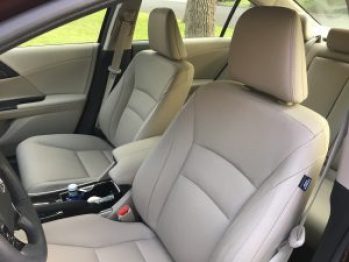 Creature comforts included Ivory leather seats, with heated seats in the front and back, navigation, dual-zone climate control (Honda seems to have addressed the air conditioning system’s habit of fading at stops in previous hybrids), a moonroof, and a multi-view back-up camera. I got used to the lack of knobs for volume control and put the CD player and the MP3 USB port to good use on several road trips.


 d, Chrysler will notify owners, and dealers will replace tire placard label, free of charge. The recall is expected to begin July 28, 2017. Owners may contact Chrysler customer service at 1-800-853-1403. Chrysler’s number for this recall is T37.

 horsepower and an estimated 109 lbs.–ft. of torque. On the Hybrid, it’s matched to a quick-shifting six-speed double-clutch transmission, an electric motor that delivers an estimated 43 horsepower with an estimated maximum torque of 125 lbs.–ft., and a 1.56 kWh lithium-ion polymer battery (with a lifetime warranty). With an 8.9 kWh lithium-ion polymer battery, the Plug-in Hybrid provides an all-electric range (before the gas-powered engine kicks in) of more than 27 miles while the Ioniq Electric offers an estimated driving range of 124 miles with a 28 kWh lithium-ion polymer battery . Mated to a single-speed reduction-gear transmission, the electric motor has a maximum output of 118 horsepower and 218 lbs.–ft. of torque. The Ioniq Electric has an EPA-estimated 136 miles per gallon gasoline equivalent (MPGe) rating, better than any electric vehicle sold in the U.S.
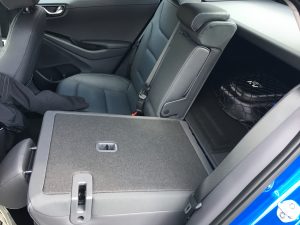 Enhancing the car’s fuel efficiency and dynamic driving characteristics, the
  driver can select either SPORT or ECO modes. On the launch, the SPORT mode did add oomph but it was the Plug-in Hybrid and Electric models that offered noticeably smoother rides.

 as just named “10 Best” for the thirty-first time by Car and Driver, an unprecedented honor for any vehicle. But as the name implies, the model I’m driving is a hybrid and its fuel-saving powertrain is its centerpiece.
 To maximize fuel efficiency, there’s an Econ button that can be used at all times, as well as an EV button that when engaged, operates the hybrid on electric power only for small distances. When I need more power, I push the Sport mode button to give the hybrid a noticeable amount of giddy-up.


 No review of a hybrid can ignore fuel economy. The ES 300h has EPA estimated fuel economy ratings of 40 miles per gallon in the city and 39 mpg on the highway. I achieved an average fuel economy of 36.9 mpg.
 Pricing for the 2017 Lexus ES 300h starts at $42,795. The as-tested price came to 49,410.


