
Chevy Cruze
Available at all ends of the price spectrum, the ubiquitous sedan comes in an assortment of incarnations, from a comfortable, affordable commuter to a sumptuous performance machine. Here’s an overview of the sedans tested by Latino Traffic Report (LTR) and what makes them stand out in a crowded field.
Chevy Cruze

Redesigned in 2016, the Chevy Cruze compact sedan continues to compete in one of the toughest automotive segments by ramping up both its style and amenities.
For starters, the new version is larger and lighter, increasing its EPA estimated fuel economy to 30 miles per gallon (mpg) in the city and 40 mpg on the highway.
 The new 1.4-liter inline four-cylinder turbo engine with 153 horses is matched to a six-speed manual or available six-speed automatic transmission (North America). I drove the automatic and earned an average 35 mpg. A diesel engine becomes available in the spring of 2017.
As mentioned, it comes with a healthy list of standard features including keyless entry, XM Satellite radio (three months), OnStar (six months), OnStar Basic Plan ( five years), and a rearview camera. New available features include wireless phone charging, heated rear seats and heated, leather-wrapped steering wheel.
Happily, I drove the Premier or top-of-the-line model that included the available OnStar 4G LTE with Wi-Fi hotspot and keyless start plus all the above via the Enhanced Convenience Package ($865), as well as the Driver Convenience Package ($790) that added essentials like rear park assist, forward collision, rear cross traffic, and lane change alert with a blind zone warning.  Oddly, neither a sunroof nor leather seats are available.
Still, the fit and finish inside this model was quite impressive, definitely a step up from the outgoing model.
The as-tested pricing for the Cruze Premier came to $26,045.
Toyota Camry

The Camry is a top seller among Latinos as well as the nation. It’s been a leader in the midsize segment for the last 14 years. So if it ain’t broke, perhaps the task for Toyota is just to make more versions? The LTR test drive featured the Camry SE Special Edition. While many manufacturers have joined the darkened trend for special editions, Toyota chose to go blue.
Powered by a 2.5-liter four-cylinder matched to six-speed automatic transmission, it should achieve an impressive EPA estimated city/highway fuel economy of 25/35 mpg. I averaged 26.3 mpg. A 3.5-liter V6 is available on other Camrys.
Toyota applied the Special Edition to the SE trim as it’s already distinguished by a sporty design, from the grille to the suspension. On the inside, the sport fabric Softex seats featured blue accent stitching and blue seat inserts. Blue accents  were also included in the gauge cluster, as well as a power moonroof.
Specific technology on this trim included a Smart Key System and Qi wireless charging for compatible smart phones, enabling navigation from a smart phone.
Exclusive design features include a smoked treatment on the taillights and 18-inch alloy wheels in a machined finish and gloss black-painted accents. For a mere $525, the Camry also included a ramped up Entune premium audio with navigation, a seven-inch high-resolution touch screen with split-screen display, and a CD player.
While a redesigned 2018 version of the Camry is currently touring auto shows, there’s still time to grab the current generation.
The as-tested Camry Special Edition pricing came to $27,075.
Kia Optima

Kia ramped up the 2016 version of the Optima with a redesign, giving its top-selling nameplate a more refined exterior look, new technology, and creature comforts offered at the same starting price as the outgoing model. The 2017 model receives a few tweaks and upgraded trims.

Optima rear view camera with multiple angles.
There are three available four-cylinder engines to power the Optima, distributed among five trim levels. The test model, Optima SX Turbo, came equipped with 2.0-liter turbo-powered four-cylinder engine matched to a six-speed automatic transmission. A seven-speed dual clutch transmission is also available.
 All three engines include the Active Eco System and Driver Mode Select with an Eco option to conserve gas. The EPA estimated fuel economy for the test model is 22 mpg in the city and 32 mpg on the highway. I averaged 31 mpg.
As a midsize sedan, Kia competes in a tough segment. It has an edge, however, with an exceptional bumper-to-bumper warranty (five years or 60,000 miles) and with a healthy list of standard features. Situated near the top of the line, second to the Optima SXL, the test model included extra technology and creature comforts. Standard features on the test model included dual-zone air conditioning, cruise control, AM/FM/MP3 audio unit with satellite radio, an eight-inch LCD rear-camera display, and Bluetooth.
Additionally, the test model added the SXT Premium Technology Package ($4,800) brought a slew of features like a panoramic sunroof, Harman Kardon Surround Sound system, heated and cooled front seats, Blind spot Detection and Rear Cross Traffic Alert.
The as-tested price for the Optima, built in West Point, GA, was $35,315.
Acura ILX

Considered a gateway to the Acura brand, the ILX is the most affordable Acura model available. The test model, ILX Tech Plus A-SPEC, however, included multiple packages that ramped up its appeal and price.
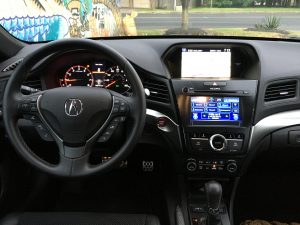 The sporty ILX gets its oomph from a 2.4-liter four-cylinder engine with 201 horsepower and 180 lb.–ft. of torque. Matched to an eight-speed dual-clutch transmission, the powertrain should achieve an EPA city/highway estimated fuel economy of 25/36 mpg. I averaged 29.9 mpg.
Expect to feel the road with the ILX which lacks adjustable drive mode se lect technology to adjust ride and handling.
With refreshed looks on the outside for 2016, including restyled front and rear fasciae, front grille, and rear LED combination lights, the A-SPEC package also added sporty side sill garnishes, a trunk spoiler, front fog lights, new 18-inch, ten-spoke machined alloy wheels, sport pedals, and sport seats with suede inserts.
As the name implied, the ILX Tech Plus A-SPEC was packed with packages that brought a long list of features starting with the Premium Package that included XM Satellite radio, a blind spot monitor and rear cross traffic monitor among other  features. The Tech Package added navigation, multi-view rear camera, and the Acura ELS AM/FM/CD sound system. Finally, the Acura Watch Plus Package completed the picture with adaptive cruise control, forward collision warning, and braking among other features.
As tested pricing for the top-of-the-line ILX Tech Plus A-SPEC came to $35,810.
Volkswagen Passat

Passat 1.8T SE
With a base price of $23,260, the Passat is more affordable than expected for a European mid-size sedan, one that happens to be built at VW’s Chattanooga, TN plant. LTR tested two Passat trim levels, the sporty 1.8T SE with Technology and the SEL Premium.
Updated inside and out for 2016, the Passat remains understated but sophisticated in appearance.
Powered by the four-cylinder 1.8-liter turbocharged engine matched to a six-speed automatic transmission should help the Passat SE achieve an impressive EPA city/highway estimated fuel economy of 25/38 mpg. I averaged 27.4 mpg.

Passat SEL Premium
The more affordable trim level of the two I drove included important technology like the intelligent crash response system, but also comfort features like heated front seats and MIB II, the new generation of Volkswagen’s infotainment system, adaptive cruise control and a rearview camera for added convenience.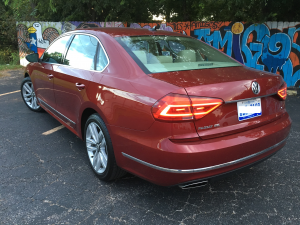
As the name implies the SEL Premium is the higher-end version of the Passat and replete with more bells and whistles that do come at a high price, nearly $10,000 more.
Powered by a 3.6-liter V6 and a six-speed transmission, it has an EPA city/highway estimated fuel economy of 20/28 mpg. I averaged 24.3 mpg.
It had heated front and rear leather seats, a Fender premium audio system, a power sunroof, parking sensor, and a blind spot monitor.
Both models had a massive truck with 15.9 cubic feet of storage and 60/40-split rear seat that easily deploys to expand cargo room inside.
As-tested pricing for the SE and SEL came to $28,195 and $37,655 respectively.
Audi A3

Audi A3 Sedan
Believe it or not, there’s actually an entry-level Audi and it’s called the A3. On this test for LTR, there were two models for review, the Sedan and the Cabriolet (convertible).
The Sedan offers three engine options and the Cabriolet two. Both test models shared the same one, a 2.0-liter inline four-cylinder engine that produced 220 horsepower and 258 lb.–ft. of torque matched to a six-speed S tronic transmission.  Both also came with quattro all-wheel drive, but the sedan should manage to achieve one more mile per gallon in the city and highway, with an EPA estimated fuel economy of 24/33 mpg. I averaged 23.7 mpg with the Sedan and 21.4 mpg with the Cabriolet.
What the Cabriolet did excel at was fun, starting with the canvas top that deployed with the push of a button at speeds of up to 31 mph and, ideally, in 18 seconds—it took 24 seconds when I tried.

Audi A3 Cabriolet
Standard safety technology on all A3s includes, a rear view camera, and parking system. To get advanced systems like Audi Side Assist (blind spot warning) requires purchasing the Technology Package ($2,700), which also adds a CD/DVD player, Audi MMI touch, and navigation, among other features.
The A3 may be considered “entry level” but it’s still an Audi, and as such, standard creature comforts include dual-zone climate control, leather seating, and SiriusX M Satellite radio. The sedan also came with a panoramic sunroof.
Both added extra packages to get features like heated front seats, Audi advanced Key, and Audi music interface with iPod cable.
As tested pricing for the Sedan came to $41,325 and $46,500 for the Cabriolet.
Lexus GS F

Lexus’s new design DNA, including the signature spindle grille, signaled a new focus on sportiness. The manufacturer even created a special performance lineup under the F brand. New for 2016, the GS F performance sedan leaves little doubt that it’s a Lexus, particularly with its premium appointments on the inside, but its sportiness is certainly sets it apart.
Exterior design features get bolder on F models, including the fascia with race-inspired functional air inlets, triple-beam headlamps, low-slung wide stance, large brake calipers, carbon-fiber rear spoiler, and quad exhaust rear diffuser.
 To show it means business, Lexus powers the GS F with a 5.0-liter V8 with 467 horses and 389 lb.–ft. of torque. It’s matched to an eight-speed Sport Direct Shift Automatic Transmission with steering wheel mounted paddle shifters.
Fuel economy will not be its strongest feature but it is respectable. The EPA estimated city/highway fuel economy is 16/24 mpg. I averaged 17.7 mpg.
 For better performance and handling, the GS F sits on a double-wishbone in the front and rear multi-link suspension. Lexus adds Brembo disc brakes and Active Sound Control, to increase throatiness and rumble to the engine and exhaust notes. Drive Mode Select control further enhances performance by giving the driver the following options—NORMAL, ECO, SPORT S, SPORT S+—while Torque Vectoring Differential helps the GS F hug the road.
 All new for 2016, improvements in 2017, like a new Linear Adaptive Variable Suspension, accentuate the positive, with more power and better responsiveness.
All this performance and power doesn’t come cheap. The as-tested pricing for the GS F was $87,175.


 “Across the board, our data tells us that Spanish-speaking customers are well-informed when it comes to in-vehicle technology,” Inch said. “In addition to using OnStar core services, we’ve seen that Spanish-speaking customers are likely to use the myChevrolet mobile app to remote start their vehicles, lock their cars and even check their vehicle’s diagnostics.”


 When you step up from a Honda to an Acura, you might expect a little more bells and whistles. You can get ’em, but at a price. TLX models with the 2.4-liter engine can be upgraded to the Technology package and models with the 3.5-liter engine can add Technology or the line-topping Advance Package. Both were included on the test model. The Technology package brought essential features like blind spot information, forward collision warning, and a rear cross traffic monitor, as well as convenience features like perforated leather seating, navigation with voice recognition, the AcuraLink communication system, and Acura ELS Studio premium audio.
 The Advance package added Collision Mitigation, Adaptive Cruise Control, ventilated front seats, and front and rear parking sensors, among other features.


 Why last’s years No. 1 fell in rankings:

 The test model came in the most striking of three available shades, Sandstorm Yellow, but subtle design cues also differentiate the Dune from its siblings. It has new front and rear fascias and black wheel arches, plus it rides a little higher and sits a little wider. The bumper adds s a large central air intake and on either side, two black honeycomb vents contain the foglights. It sits on 18-inch aluminum-alloy wheels and has “Dune” graphics displayed on both doors. At the back, the Dune sports a large rear spoiler, standard LED taillights, and a new bumper design. In other words, it’s a head turner.
 Standard entertainment features include the Composition Media infotainment system with a 6.3-inch screen and a capacitive touch sensor and a proximity sensor that detects when a hand is nearby and automatically switches its display. Volkswagen Car-Net App-Connect, USB and Bluetooth connectivity for compatible devices and an AM/FM/HD radio with SiriusXM Satellite radio, and a CD player are included
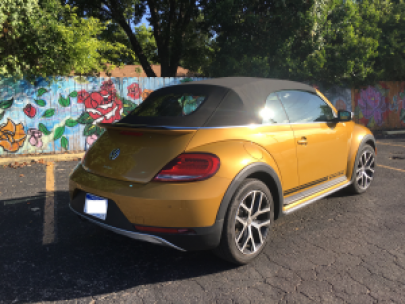 Additional standard safety features on the test model included a rearview camera and the Park Distance Control (ParkPilot) system, Automatic Post-Collision Braking system, and Volkswagen’s Intelligent Crash Response System. A blind spot monitor was not available.


 Like most premium SUVs, the Q7 adheres to expectations, with plush leather seating, a leather-wrapped steering wheel, tri-zone automatic climate control, and a singular infotainment system, MMI—Audi’s is less intuitive than others, but I did like that it allowed for 48 different radio presets.
 Redesigned for 2017, the second-generation Q7 has a starting price of $55,750.The as-tested price came to $72,875.
