
BMW X4 M40i at the Salt Lick Restaurant in Driftwood, Texas.
In 2008 BMW redefined the meaning of a coupe, sedan, and sport utility vehicle (SUV) when it introduced the X6 sport activity coupe (pronounced coup-ee). Hoping to appeal to buyers with a need for utility as well as speed, apparently, the gamble paid off because BMW added the new X4, a smaller version of the X6, to the segment last year. I recently drove the sporty 2017 X4 M40i trim level for Latino Traffic Report and found it to be the perfect vehicle for a road trip.
Larger than a sedan but smaller than an SUV, it offers the best attributes of both—positioning the driver higher in the driver’s seat for a better vantage while handling more like a sports car than an SUV. Its size also expanded the cargo room to 49.4 cubic feet with the second-row seat folded flat for added versatility.
“We started the segment in 2008 with the X6 Sports Activity Coupe, a unique design concept and driving dynamics never seen before, ideal for people who are searching for the added space and practicality of an SAV (Sports Activity Vehicle, i.e. X3, X5) but also crave the aesthetics and dynamic driving experience of a coupe,” explains Hector Arellano-Belloc, BMW product and technology spokesperson. “Like its larger sibling, the BMW X6, the X4 offers the unique blend of style, driving dynamics and all-road capability that can only be offered by a BMW Sports Activity Coupe.”
 The M performance classification on the test model brought sport performance specifications starting with the new TwinPower Turbo inline six-cylinder gasoline engine that delivered 355 horsepower and a maximum torque of 343 lb.–ft. It’s matched to an eight-speed Steptronic automatic transmission with paddle shifters on the steering wheel for added sportiness. This combination gives the X4 M40i a best-in-class zero–60 miles per hour acceleration of 4.7 seconds.
M performance also added suspension technology that included four driving modes, Eco, Comfort, Sport, and Sport+, for added performance. Along the drive, I tested all four and found that the Sport+ really boosted power and steering tightness along curvy roads. Though not as much fun, the Eco Pro mode did help make the X4 M40i more fuel efficient, a rare attribute for a performance vehicle. At the end of a weeklong test drive, I averaged 22.5 miles per gallon (mpg) above the EPA estimated average fuel economy of 21 mpg.
 The X4 M40i matched a handsome exterior with an elegant interior that included Nevada leather seating, real wood trim, the Harman Kardon surround sound stereo system, a moonroof, a leather steering wheel, keyless entry with a push button start, and a one-year subscription to satellite radio. The stereo system even included a CD-player.
The X4 M40i that I tested did come up a little short on safety features, e.g. it lacked a blind spot monitor. I also found it odd that a rearview camera, something many premium brands include as standard, cost an additional $400.
The X4 M40i did include intelligent BMW xDrive all-wheel drive that improved traction, especially in rainy conditions, Park Distance Control parking sensors in the front and rear, and Intelligent Emergency Call that can be engaged manually or automatically in an emergency.
Pricing for the 2017 X4 starts at $46,550 including destination fees. The test model included several optional packages, like the Cold Weather Package ($950) that added a heated steering wheel and heated seats in the front and back, and the Technology Package ($2,750) that added navigation, a head-up display, and BMW Online and Apps. Even the distinctive exterior shade of Melbourne Red Metallic cost $700 extra. This brought the as-tested pricing for the 2017 X4 M40i to $67,495.

The 2017 X4 M40i at the LBJ Ranch in Johnson City, TX.
Sí: Great styling, performance, and versatility for a performance vehicle.
No: Packages that add features normally found on a premium vehicle, like navigation and a back-up camera, escalate pricing dramatically.


 The front-wheel-drive test model did not offer Compass’s best-in-class 4×4 off-road ability, but it did have some of the new features for 2017, like a 3.5-inch LED driver information display (DID) instrument cluster, Uconnect 5.0—one of four new Uconnect infotainment systems—displayed on a rather diminutive touch screen, a capless fuel filler, push button start, ParkView Backup camera, and Remote Keyless Entry.
 While driving around town, the TPMS warning light appeared. Some TPMS systems just show the alert icon, forcing the driver to guess which tire is low, but the DID on the Compass displayed PSI levels for all four tires so that I was able to monitor the leak. Upon returning home, I could hear the sound of air hissing from the left rear tire and by the next day, Sunday, it was flat. With plans to fly out of Austin on Monday, I had to find a quick fix.
 The test model also included the Technology Group ($495) with the Park Sense rear park assist system and Sport Appearance Group ($595) with 16-inch wheels and tinted glass. It did not, however, come with a blind spot monitor or forward collision warning technology, nor are these technologies available on this trim level.

 As the word implies, a redesign starts on the outside. Defined by Hyundai’s signature hexagonal grille, the new Elantra also has smoother contoured lines that enhance its aerodynamics. The redesign also includes equipment firsts like the available HID headlights with Dynamic Bending Lights, unique vertical LED daytime running lights, the LED door handle approach lights, and LED taillights.
 Stepping up to the Limited trim level brings many more advantages, particularly when it comes to safety features. Standard advanced safety features include a rearview camera, Blind Spot Detection with Rear Cross-traffic Alert and Lane Change Assist. Surprisingly, some premium brands still include a blind spot monitor on an optional package so I’m always happy to find this critical safety feature included as standard equipment. Still, I would like to see it available throughout the lineup but it’s not available on the base SE with a six-speed manual transmission, it comes with a blind spot mirror on the driver’s side instead.


 Long-term test drives beg for a car to be driven, so I did, more than 5,000 miles over Texas highways, to small towns, like Burnet and Bryan, and big cities, like Houston, Dallas, and San Antonio. It’s a comfy ride over the long haul and nimble enough to scoot through traffic.
 At the heart of its fuel saving ability is its two-motor hybrid system combined with an ultra-efficient 2.0-liter i-VTEC Atkinson Cycle engine and matched to an electric continuously variable transmission. It achieves a peak-combined output of 212 horsepower, the highest of any midsize hybrid sedan.
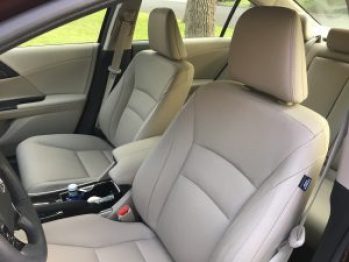 Creature comforts included Ivory leather seats, with heated seats in the front and back, navigation, dual-zone climate control (Honda seems to have addressed the air conditioning system’s habit of fading at stops in previous hybrids), a moonroof, and a multi-view back-up camera. I got used to the lack of knobs for volume control and put the CD player and the MP3 USB port to good use on several road trips.

 space further. It also bears the new face of Buick, featuring a new design on its waterfall grille including the return of a three-color Buick tri-shield insignia, accented by wing-shaped elements.
 The Buick IntelliLink (left) infotainment system with a frameless eight-inch-diagonal color touchscreen featuring Apple CarPlay, Android Auto and OnStar guidance for three months, OnStar 4G LTE with Wi-Fi hotspot integration three-month data plan, and OnStar five-year basic plan with limited vehicle mobile app features, monthly diagnostics report, and dealer maintenance notification are standard on all trims,


 While SUVs aren’t known for their fuel efficiency, the new Acadia is 700 pounds lighter, which should help stretch a gallon of gasoline a little farther.
 The test model also included the All Terrain package with badging throughout, an advanced Active Twin Clutch AWD system, 20-inch aluminum wheels, a cargo management system, and seating for five. While the Acadia can offer seating for seven, the All Terrain package replaces the third-row of seating with covered storage bins and a cargo management system in the rear cargo floor. For this trip, we focused on storage above the floor. The second row deployed easily to expose 79 cu. ft. of cargo space. We had room for multiple boxes and bags, but most impressive, was that the Acadia also fit a twin mattress. We didn’t need to tow but if we had, the Acadia included a Trailering Package ($650) that gives it a maximum towing capability of 4,000 pounds.
 The user-friendly GMC IntelliLink system has been enhanced to include phone integration technology via Apple CarPlay and Android Auto compatibility. The test model also included navigation, a 4G LTE WiFi hotspot, OnStar, and SiriusXM Satellite radio for three months, as well as a panoramic sunroof. The shade, however, snaps back with some force so little fingers may need to beware.
 More common safety technology, like a blind spot monitor and rear cross-traffic alert, are available on the SLE-2 trim and are standard on the SLT-1 trim and above. Advanced technology like forward collision alert and the safety alert seat that vibrates to warn the driver, come with the Driver Alert Package II, standard only on SLT-2 and Denali trims.


 When you step up from a Honda to an Acura, you might expect a little more bells and whistles. You can get ’em, but at a price. TLX models with the 2.4-liter engine can be upgraded to the Technology package and models with the 3.5-liter engine can add Technology or the line-topping Advance Package. Both were included on the test model. The Technology package brought essential features like blind spot information, forward collision warning, and a rear cross traffic monitor, as well as convenience features like perforated leather seating, navigation with voice recognition, the AcuraLink communication system, and Acura ELS Studio premium audio.
 The Advance package added Collision Mitigation, Adaptive Cruise Control, ventilated front seats, and front and rear parking sensors, among other features.


 The test model came in the most striking of three available shades, Sandstorm Yellow, but subtle design cues also differentiate the Dune from its siblings. It has new front and rear fascias and black wheel arches, plus it rides a little higher and sits a little wider. The bumper adds s a large central air intake and on either side, two black honeycomb vents contain the foglights. It sits on 18-inch aluminum-alloy wheels and has “Dune” graphics displayed on both doors. At the back, the Dune sports a large rear spoiler, standard LED taillights, and a new bumper design. In other words, it’s a head turner.
 Standard entertainment features include the Composition Media infotainment system with a 6.3-inch screen and a capacitive touch sensor and a proximity sensor that detects when a hand is nearby and automatically switches its display. Volkswagen Car-Net App-Connect, USB and Bluetooth connectivity for compatible devices and an AM/FM/HD radio with SiriusXM Satellite radio, and a CD player are included
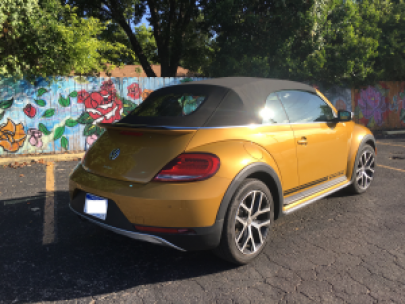 Additional standard safety features on the test model included a rearview camera and the Park Distance Control (ParkPilot) system, Automatic Post-Collision Braking system, and Volkswagen’s Intelligent Crash Response System. A blind spot monitor was not available.

 Like most premium SUVs, the Q7 adheres to expectations, with plush leather seating, a leather-wrapped steering wheel, tri-zone automatic climate control, and a singular infotainment system, MMI—Audi’s is less intuitive than others, but I did like that it allowed for 48 different radio presets.
 Redesigned for 2017, the second-generation Q7 has a starting price of $55,750.The as-tested price came to $72,875.
 as just named “10 Best” for the thirty-first time by Car and Driver, an unprecedented honor for any vehicle. But as the name implies, the model I’m driving is a hybrid and its fuel-saving powertrain is its centerpiece.
 To maximize fuel efficiency, there’s an Econ button that can be used at all times, as well as an EV button that when engaged, operates the hybrid on electric power only for small distances. When I need more power, I push the Sport mode button to give the hybrid a noticeable amount of giddy-up.
