
Determined to end deaths or serious injury in a Volvo vehicle by the year 2020, the Swedish automaker encroaches on that goal with every new model or redesign. The 2018 version of the XC60 mid-size utility vehicle (SUV), for example, gets three new collision avoidance safety features. I recently drove the XC60 at the launch in Barcelona, Spain for Latino Traffic Report. For those who haven’t been to Barcelona, imagine San Francisco—the two are strikingly similar. That backdrop would complement any car, but the 2018 XC60 stood out for its own assets, i.e. beautiful design combined with cutting edge safety and powertrain technology.
The midsize SUV has been a popular addition to the Volvo lineup. According to Volvo, over one million XC60s have been sold globally since it was introduced in 2008 and the vehicle represents 30 percent of Volvo Cars’ global sales.
Car buyers already benefit from Volvo safety innovations, like the three-point seat belt or the Blind Spot Indication System (BLIS). New safety updates on the XC60’s Intellisafe City Safety system include Oncoming Lane Mitigation that uses steering assistance to prevent drivers from changing lanes into other vehicles. Steering assistance has also been applied to BLIS for the new XC60. It may feel like a “ghost in the machine” but when tested in Spain, the  nudge it provides is just enough to get the driver’s attention but not so strong as to be alarming. They join standard City Safety features like pedestrian, cyclist, vehicle, and large animal detection. BLIS, however, remains optional, but we were informed at the launch that it will be a standard feature on future models. For added security, Volvo On Call with remote engine start is standard on all models for four years.
The XC60 also includes Pilot Assist, a semi-autonomous feature from Volvo. It helps with steering, braking, and acceleration on roads at speeds up to 80 miles per hour, like adaptive cruise control but without needing a car in front of it to follow. According to Volvo, it’s intended to reduce stress in “stop-and-go commuter traffic.”
Safety isn’t all that Volvo improves upon. The striking but utilitarian Scandinavian design on every model gets better and better. On the 2018 XC60, designers used driftwood to inspire wood interior accents on the Inscription trim level. According to Thomas Ingenlath, senior vice president, design Volvo Cars: “Driftwood is a material formed by the sea and colored by exposure to salt and the extreme temperatures of our unique geography. Driftwood’s naturally silvered surface is an entirely new treatment that is alive with subtle colors and texture.”
 For the test drive, we drove the T6 Inscription with the Luxury Seat Package that included heated and ventilated massaging front seats, heated rear seats, a power cushion extension on the front seats, a colorful 12.3-inch driver display for the digital instrument cluster, keyless entry, door handle illumination, and a hands free power liftgate.
To improve the ride, the XC60 sits on a new double wishbone front suspension for reduced torque and understeer and rear-wheel suspension with an integral link design. The available air suspension on the T6 and T8 features automatic leveling for improved ride stability as well as speed dependent steering, active dampers, and a Drive Mode selector with Comfort, Dynamic, ECO, Individual, and Off Road settings. All-wheel drive is standard on all XC60s.
Standard creature comforts include leather seats, a nine-inch Sensus screen that also provides a clear vantage when utilizing the standard backup camera, a panoramic sunroof, multi-zone climate control, and 4G LTE connectivity with in-car Wi-Fi hotspot. It offers seating for five and 63.3 cubic feet of cargo with rear seats folded, a loss of about four inches from the previous XC60.
 Two remarkable four-cylinder engines power the new XC60, a turbo 2.0-liter with 250 horsepower and 258 ft.–lb. of torque on the T5 base model, a supercharged and turbocharged 2.0-liter with 315 horsepower and 295 ft.–lb. of torque on the T6. Super peppy and responsive, the engine belies its size, particularly on the T6 driven at the launch. The T5, however, should be the most fuel efficient, besides the Hybrid (see below) with an EPA estimated fuel economy of 22 miles per gallon (mpg) in the city and 28 mpg on the highway.
Pricing for the 2018 XC60 starts at $42,495. The as-tested pricing was about $53,795.
The 2018 XC60 launch took place in Barcelona, but the actual test drive headed into the surrounding countryside. While the route held certain challenges, like distracting Catalonian vistas and road signs en español, I knew the XC60 had my back.
—Valerie Menard

The new Volvo XC60 T8
Volvo Completes XC60 Lineup with the T8 Hybrid Launch
Volvo sees the future of cars as being electric and self-driving, and the 2018 XC60 T8 electric/hybrid is an early favorite in what will be a very competitive field. Recently launched in Denver, CO, the T8 hybrid is powered by a four-cylinder twin engine that delivers 400 hp and 472 ft.–lb. of torque matched to an electric motor and lithium ion battery. It has an EPA estimated combined fuel economy of 59 mpge.
To enhance ride and handling, the Hybrid model offers six drive modes—Hybrid, Power, Pure, Individual, Off-Road, and AWD.

I had the opportunity to spend some time in the T8 trim, which really is worth considering if electric power is important to you. Be advised, the T8 is great for highway driving, beautiful for a ride, impressive on the inside and out, but not racing. It handled beautifully at the launch, as it went through curves and challenges all along the Rocky Mountains. The power, however, is a bit crimped and stalled, but that’s how these electric/hybrid types are. You don’t get from electricity what you get from gas, and that can be a bit disappointing to your ears and your heart.
Clearly, the Swedes are taking aim at impressive luxury crossovers like the Audi Q5, BMW X3 and Mercedes-Benz GLC. The market for these vehicles is very competitive and promises to get even more so, but that’s great for buyers who today have more choices than ever before. All this and all the luxury and precision for which Volvo is known is on full display here.
On sale now, pricing starts at $53,895.
—Sammy Gomez


 Inside, there’s also 3.5 cubic feet of interior volume for a total of up to 63.5 cubic feet of maximum cargo space, this despite a reduction in overall length of 4.7 inches, making it easier to park and maneuver.
 The MyLink infotainment system designed to support Apple CarPlay and Android Auto, as well as the OnStar 4G LTE Wi-Fi hotspot, can be matched to a standard seven- or an available eight-inch-diagonal color touchscreen. Other convenience features include cruise control, air conditioning, and keyless start.


 “This is the biggest and boldest Volkswagen we have ever built in the United States, delivering the distinctive design and craftsmanship we’re known for, now with room for seven,” said Hinrich J. Woebcken, CEO of the North American Region, Volkswagen. “The Atlas marks a brand new journey for Volkswagen to enter into the heart of the American market.”

 For those a little more concerned with fuel economy, the Atlas will offer a 2.0-liter turbocharged four-cylinder engine that produces 235 horsepower and 258 lb.–ft. of torque. For families who’d like more power, the Atlas can also be outfitted with a 3.6-liter VR6 that delivers 276 horses and 266 lb.–ft. of torque. Both are matched to an eight-speed transmission. The maximum towing for the V6 is 5,000 lbs. with a factory-installed hitch. The standard Start/Stop technology on both engines that cuts the engine off at a stop, also helps conserve gas and while noticeable, it was less jarring than other systems.
 EPA testing is still underway, but the front-wheel drive VR6 models are expected to earn around 18 miles per gallon (mpg) in city driving and 25 mpg on the highway. As the 2.0-liter engine will have late availability, no mpg information is currently available.
 Standard convenience features include a rearview camera, two-zone (first row and second/third row) climate control, cruise control, the MIB II infotainment system, and a 6.5-inch capacitive touchscreen display.

 horsepower and an estimated 109 lbs.–ft. of torque. On the Hybrid, it’s matched to a quick-shifting six-speed double-clutch transmission, an electric motor that delivers an estimated 43 horsepower with an estimated maximum torque of 125 lbs.–ft., and a 1.56 kWh lithium-ion polymer battery (with a lifetime warranty). With an 8.9 kWh lithium-ion polymer battery, the Plug-in Hybrid provides an all-electric range (before the gas-powered engine kicks in) of more than 27 miles while the Ioniq Electric offers an estimated driving range of 124 miles with a 28 kWh lithium-ion polymer battery . Mated to a single-speed reduction-gear transmission, the electric motor has a maximum output of 118 horsepower and 218 lbs.–ft. of torque. The Ioniq Electric has an EPA-estimated 136 miles per gallon gasoline equivalent (MPGe) rating, better than any electric vehicle sold in the U.S.
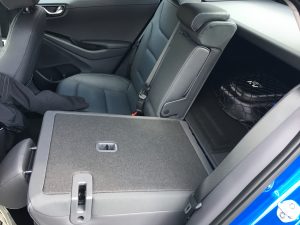 Enhancing the car’s fuel efficiency and dynamic driving characteristics, the
  driver can select either SPORT or ECO modes. On the launch, the SPORT mode did add oomph but it was the Plug-in Hybrid and Electric models that offered noticeably smoother rides.


 As a five-door hatch it offers more versatility than a coupe or sedan, including a best-in-class cargo capacity of 25.7 cubic feet of room and an innovative cargo cover that retracts to the side rather than from the top for added convenience.
 Honda’s version of a blind spot monitor, LaneWatch, is standard on the EX trim and above, which excludes the LX and Sport.
 No family vehicle is complete without a discussion of safety features and the CR-V has a story to tell. For the first time it will offer (except on the base model) both Road Departure Mitigation and Adaptive Cruise Control with Low-Speed Follow. Additional new available driver-assistive features that could be considered must-haves include a Rear Cross Traffic Monitor, Blind Spot Information System, Auto High-Beam and the all-new Driver Attention Monitor.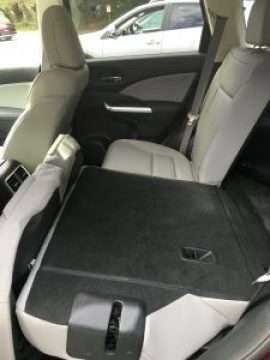
 All-wheel-drive (AWD) models feature an upgraded Real Time AWD system with a significant increase in maximum rear-wheel torque delivery.
 Impressive fuel economy from an all-new hybrid version—the first ever for Rogue— and enhanced technology and versatility should help the crossover utility vehicle (CUV) remain the top-selling Nissan model, while the new SR Turbo trim for the Sentra adds sportiness to the lineup.
 Standard safety features include a RearView monitor, remote keyless entry, traction control, and Vehicle Dynamic Control. The available Rogue Safety Shield expands that list, adding a blind spot monitor, rear cross-traffic alert, Intelligent Cruise Control, and Forward Emergency Braking with Pedestrian Detection.


 Like the Titan and Pathfinder, we tested the Armada on-road and off-road at the launch (see videos below), but we also enjoyed its comfort and convenience. This is after all, a premium SUV, in accoutrements as well as pricing. Like the Titan, it was also recognized at the 2016 TAWA Truck Rodeo, winning the title of SUV of Texas.
 Standard Armada creature comforts include, a push button ignition, heated front seats, dual-zone climate control, an eight-inch color display, and Bose audio system. The Armada SV offers premium cloth seating surfaces, while leather-appointed seating is standard on SL and Platinum grades. The Platinum adds a heated steering wheel, ventilated front seats, and heated second-row sets.

 and boomerang-shaped headlights with LED daytime running lights. It also receives a new, more powerful V6 for an increased tow rating of 6,000 lbs.
 New available safety technology includes Forward Emergency Braking, Intelligent Cruise Control, and Moving Object Detection that has been added to the available Around View Monitor. The Blind Spot Warning and Rear Cross Traffic Alert systems remain optional.


